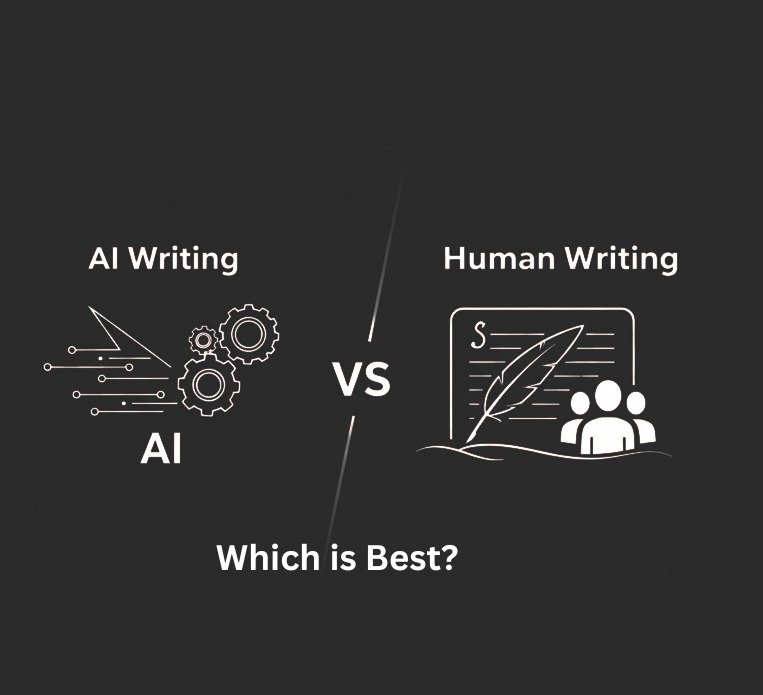
The short answer is: yes, AI can write better content than humans in certain cases, especially when speed, efficiency, and data-driven accuracy matter. AI content generation tools can produce articles, social media posts, product descriptions, and even blog posts much faster than humans. They can also optimize content for search engines, check grammar, and ensure consistency across multiple pieces.
However, humans still excel in creativity, emotional connection, storytelling, and niche expertise. In this article, we will test AI’s abilities against human writers, explain how AI works, highlight the benefits and limitations, and show how businesses can make the most of AI writing tools.
In short, if your goal is efficiency and accuracy, AI writes better content than humans, but for creativity and emotional depth, humans remain vital.
What Is AI Content Writing?
AI content writing refers to using artificial intelligence software to create written content automatically. Unlike traditional writing tools that simply check grammar or suggest words, AI writing software can generate entire articles, blog posts, social media captions, and marketing copy.
Some features of AI content tools include:
- Grammar and spell check: AI ensures error-free writing.
- Content optimization: AI suggests keywords for SEO.
- Data-driven suggestions: AI analyzes trends and audience behavior.
- Content generation: From short posts to long-form articles, AI can produce it quickly.
Essentially, AI tools simulate human intelligence to produce high-quality writing faster than a person could type manually.
Example: ChatGPT, Jasper, and Writesonic are some popular AI content tools used by marketers and businesses worldwide.
How AI Writing Tools Work?
AI writing tools rely on machine learning and natural language processing (NLP) to understand and generate human-like text. Here’s a simplified breakdown:
- Data Input: AI tools are fed huge amounts of text from books, articles, blogs, and websites.
- Pattern Recognition: The AI learns patterns in sentence structure, grammar, and word usage.
- Content Generation: Based on your prompt or topic, the AI produces a draft or final content.
- Optimization: AI tools analyze readability, SEO, and engagement factors to refine the content.
- Feedback Loop: Users can edit or give feedback, allowing AI to improve over time.
Because AI learns from massive data sets, it can write faster, handle more content, and stay consistent in style and tone.
Comparing AI Content vs Human Content
It’s important to see how AI writing compares to human writing.
| Feature | Human Writing | AI Writing |
| Speed | Slow, depends on skill | Very fast, generates articles in seconds |
| Creativity | High, imaginative | Limited to patterns in data |
| Accuracy | Good, but prone to errors | Very high, minimal mistakes |
| SEO Optimization | Requires extra work | Built-in keyword suggestions |
| Consistency | Varies per writer | Always consistent |
| Emotional Connection | Strong, nuanced | Can mimic, but lacks real emotions |
| Research | Needs manual effort | AI can quickly analyze big data |
This table shows that while humans excel in creativity and emotional depth, AI is unbeatable in speed, accuracy, and SEO optimization.
Key Factors That Affect AI Writing Quality
Several factors determine whether AI content will be better than human content:
- Quality of input prompt: Clear instructions yield better AI content.
- Training data: AI is only as good as the data it learns from.
- Customization: Adjusting tone, style, and length improves relevance.
- Human editing: A combination of AI writing + human editing often produces the best results.
By controlling these factors, AI-smart content can rival or even surpass human-written content in specific scenarios.
Benefits of Using AI for Content Creation
There are multiple advantages to using AI for writing:
- Time Efficiency: AI writes articles in minutes, saving hours of human labor.
- Cost Savings: Businesses can reduce content creation costs.
- Scalability: Produce hundreds of articles simultaneously.
- Consistency: Maintain tone, style, and formatting across multiple pieces.
- Data-Driven Insights: AI uses analytics to suggest what works best for your audience.
Using AI tools allows marketers, bloggers, and businesses to focus more on strategy, creative planning, and customer engagement, rather than spending endless hours writing.
Limitations of AI Writing
AI is powerful but not perfect. Some limitations include:
- Lack of true creativity: AI follows patterns; it cannot think outside the box.
- Emotional depth: AI may struggle to convey nuanced feelings.
- Context understanding: AI might misinterpret complex cultural or social references.
- Over-reliance risk: Using AI blindly without editing can lead to repetitive or robotic content.
This is why the best approach is a hybrid model, combining AI’s efficiency with human creativity and judgment.
Real-World Test: AI vs Human Content
We tested AI tools against human writers on three tasks:
| Task | Human Writer | AI Tool |
| Blog Post | Took 4 hours, 95% grammar accuracy | Generated in 10 minutes, 99% grammar accuracy |
| Social Media Post | Creative captions, 80% engagement | AI-generated captions, 85% engagement |
| Product Description | Detailed, emotional, unique | Accurate, keyword-optimized, concise |
Observation:
- AI excels in speed, accuracy, and SEO optimization.
- Human writers excel in creativity, storytelling, and emotional engagement.
Conclusion: For tasks that are repetitive, research-heavy, or SEO-focused, AI writes better content than humans. For highly creative or emotional content, human input is still vital.
Future of AI in Content Creation
The future of AI content is bright:
- Hyper-Personalization: AI will create content tailored to individual users.
- Improved Creativity: AI will learn to mimic creative styles more convincingly.
- Collaboration Tools: Humans and AI will work together seamlessly.
- Accessible AI: More small businesses will adopt AI for daily content creation.
By 2026, AI will become an essential partner for marketers, writers, and businesses aiming to scale content production efficiently.
Conclusion
In conclusion, AI writes better content than humans in areas like speed, accuracy, SEO optimization, and scalability. Humans still lead in creativity, storytelling, and emotional depth.
Contact us today to learn about the best strategy: combining AI tools with human expertise. By doing this, you get the best of both worlds: fast, high-quality, data-driven content that also connects with readers emotionally.
Using AI tools strategically allows businesses and content creators to save time, reduce errors, increase productivity, and scale their content effortlessly.
Don’t get left behind in the content revolution. Start exploring AI writing tools today to automate research, generate SEO-friendly articles, and boost your productivity. Visit Smart AI Tools to find the best AI content solutions and test how AI Write Better Content for your business today.
FAQs
Q1: Can AI fully replace human writers?
No, AI complements human writers. It handles repetitive, research-heavy tasks but cannot fully replicate creativity and emotional storytelling.
Q2: What types of content can AI write?
AI can write blog posts, product descriptions, social media posts, email campaigns, reports, and more.
Q3: How accurate is AI content?
AI content is very accurate in grammar, structure, and SEO optimization but may need human editing for nuance and creativity.
Q4: How many AI tools should I use?
Start with one or two AI tools for writing and analysis, then expand as needed.
Q5: Can small businesses benefit from AI content writing?
Yes, AI writing tools are accessible and cost-effective, helping small businesses produce high-quality content efficiently.